Most bass players spend years running one-octave scales up and down the neck and wondering why it is not translating into real music. Running a scale straight up and back is a hand exercise, and it is simply not the way you are going to use the thing when you are playing a song. Scales match chords, and your real job is knowing where every scale note lives on the fingerboard so that your hands just go there without you having to think about it. The approach I teach is a number system that turns the 12 keys into one set of shapes, and once you internalize it the neck really does open up.
Scales as language, notes as alphabet
I look at music as a language, and if you are going to play it, you need to treat it like one. The notes are the alphabet, the scales are the way that vocabulary gets organized, and your lines are the sentences. Letters are organized into words, words into sentences, and notes are organized into scales for a lot of the same reason. It is a way to organize the material so that you can use it to communicate.
Looking at it that way also tells you a lot about how to practice. Kids do not sit down and memorize sentence structure before they start talking, they listen, imitate, and talk. Music tends to get taught backwards, from the technical end first, and for a lot of students that is exactly why it never clicks, because there is nothing to relate it to yet. Learn to play first, then study the grammar. What I try to do in my own teaching is blend those two areas together, getting you playing while I name what you are doing.
Why a major scale is what it is
What makes a scale what it is comes down to the pattern of distances between the notes. An interval is just a distance in sound between two notes, the smallest one in Western music is the half step, the next biggest is the whole step, and a major scale is one specific sequence of them (whole, whole, half, whole, whole, whole, half). Change that pattern anywhere along the way and it is not a major scale anymore.
Call the starting note 1. In the key of A, A is 1. The next note happens to be B, and B itself is really not important here, it just happened to be at the right place at the right time. What matters is that it is 2, and 2 is always a whole step up from 1. You cannot call something 2 unless it has that relationship to 1. Then 3 is a whole step up from 2, 4 is a half step up from 3, 5 is a whole step up from 4, 6 a whole step, 7 a whole step, and 1 again a half step up from 7. Every scale gets defined by that same kind of relationship, so you establish 1 and then you look at the distances from there.
Seven box shapes, one set of names
Break the scale down into three scale notes per string, and let each scale note on your lowest string start its own shape, or what I call a "box" of notes. In the key of A, the three lowest scale notes per string starting on E give you a shape. I don't call that the E box. I call it the five box, because E is the 5 of A major. The shape gets its name from the note function of its lowest note and not from the pitch.
The shape next to it starts on F#, which is 6, so that one is the six box. The one after that is the seven box. There are seven shapes in all, one for each scale degree, and the whole point of the thing is that those shapes are the same in every key. They may sit in a different place on the neck, but the shapes do not change, and the relationship of one shape to the others does not change either. Identifying them with numbers turns the 12 keys into one thing, and that simplifies the whole business tremendously!!
Pick a key, say C. The seven box starts on 7, and 7 is always a half step below 1, so you find your C, drop a half step, and play the very same shape you played in A. Once you know that one box is here and the next one is there and the next one is there, all of a sudden you know where everything is, and you are navigating by note function instead of memorizing positions.
Here is the page I hand my students for this, so you can see what I mean. It is A major, the same key I have been using, with every note on the neck written out and the scale notes circled by their function. The eighth box is the first one again an octave up.
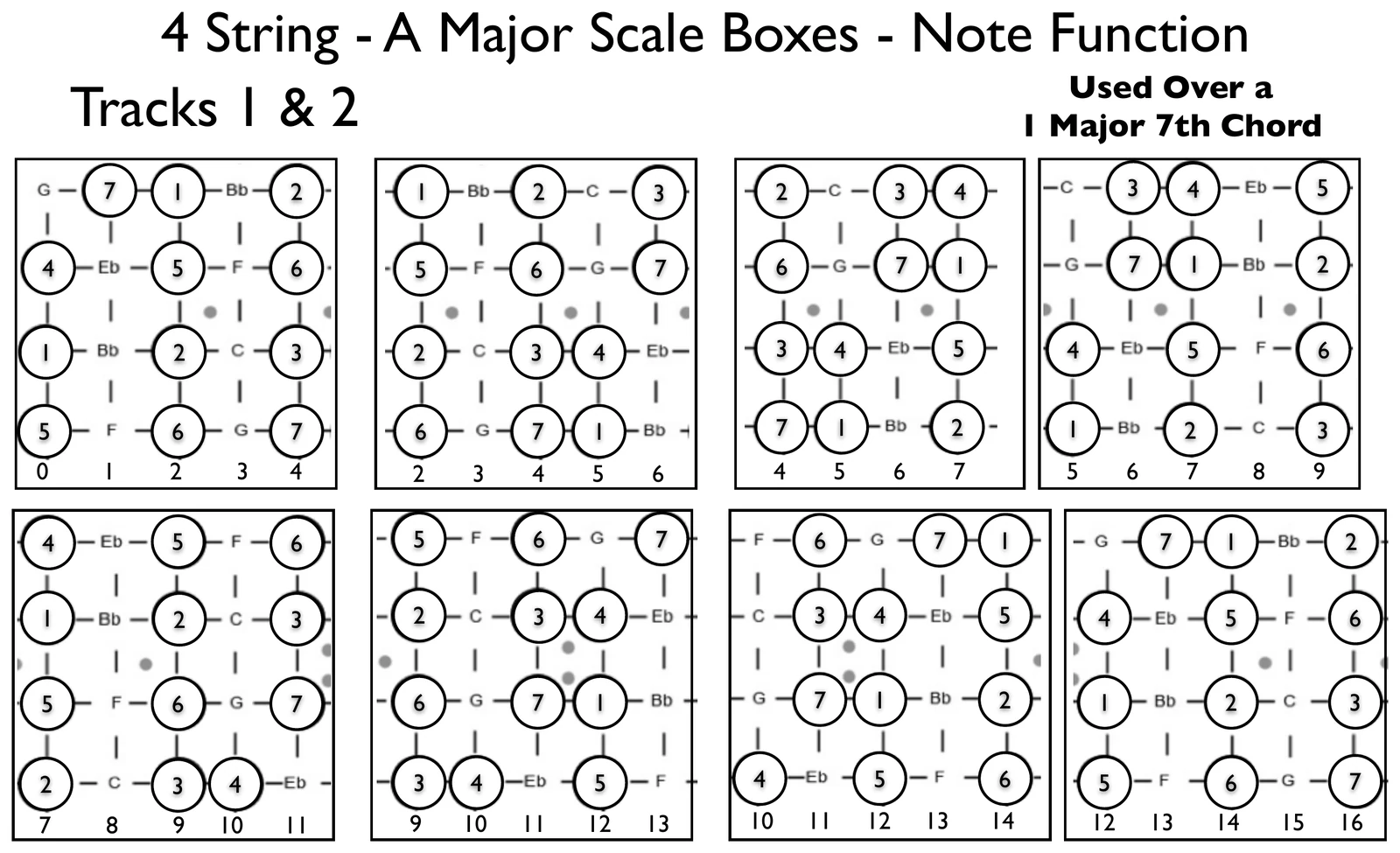
The same page exists for five and six string, because the idea does not change with the instrument, only the number of strings you have to lay it across.
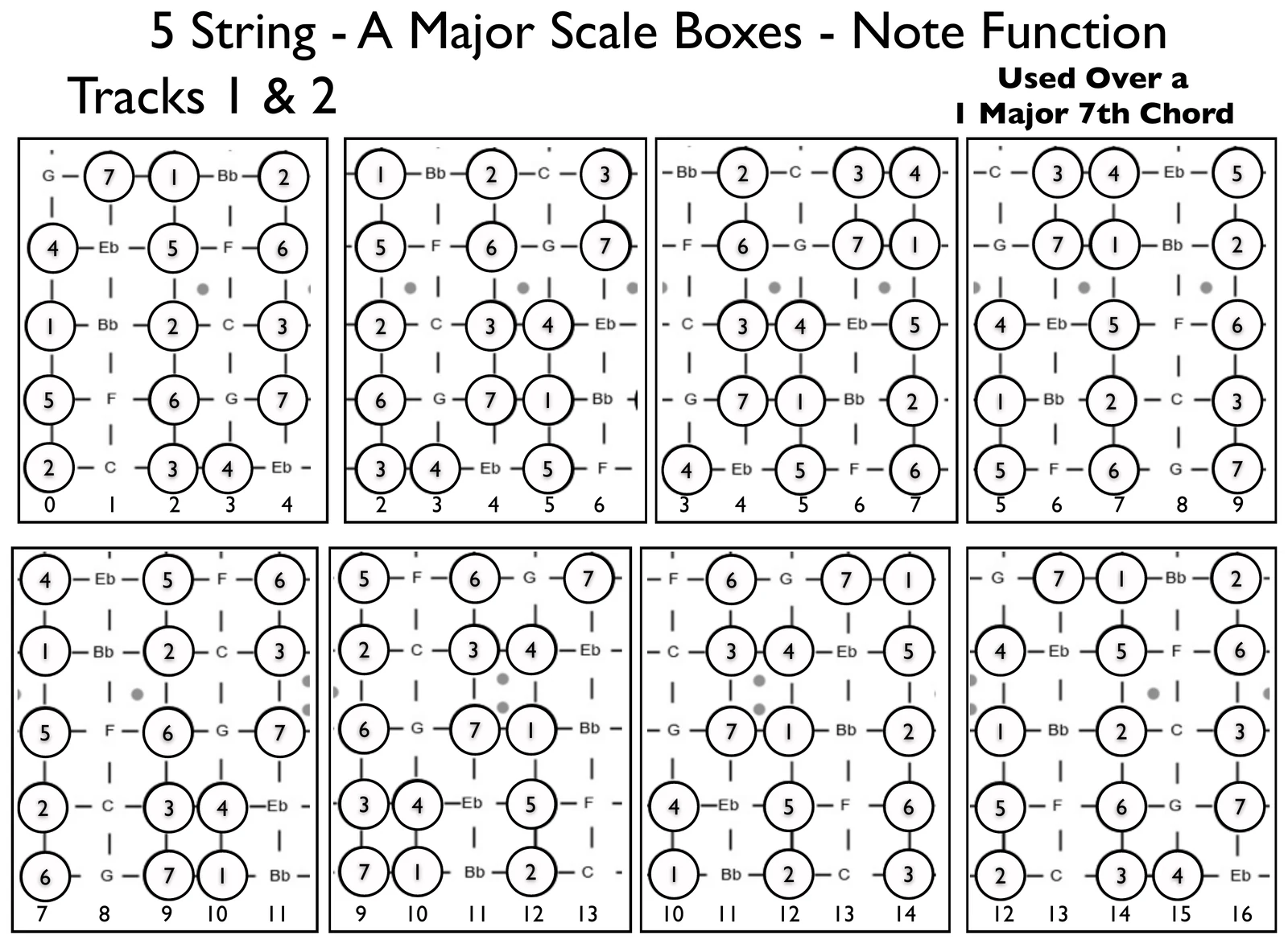
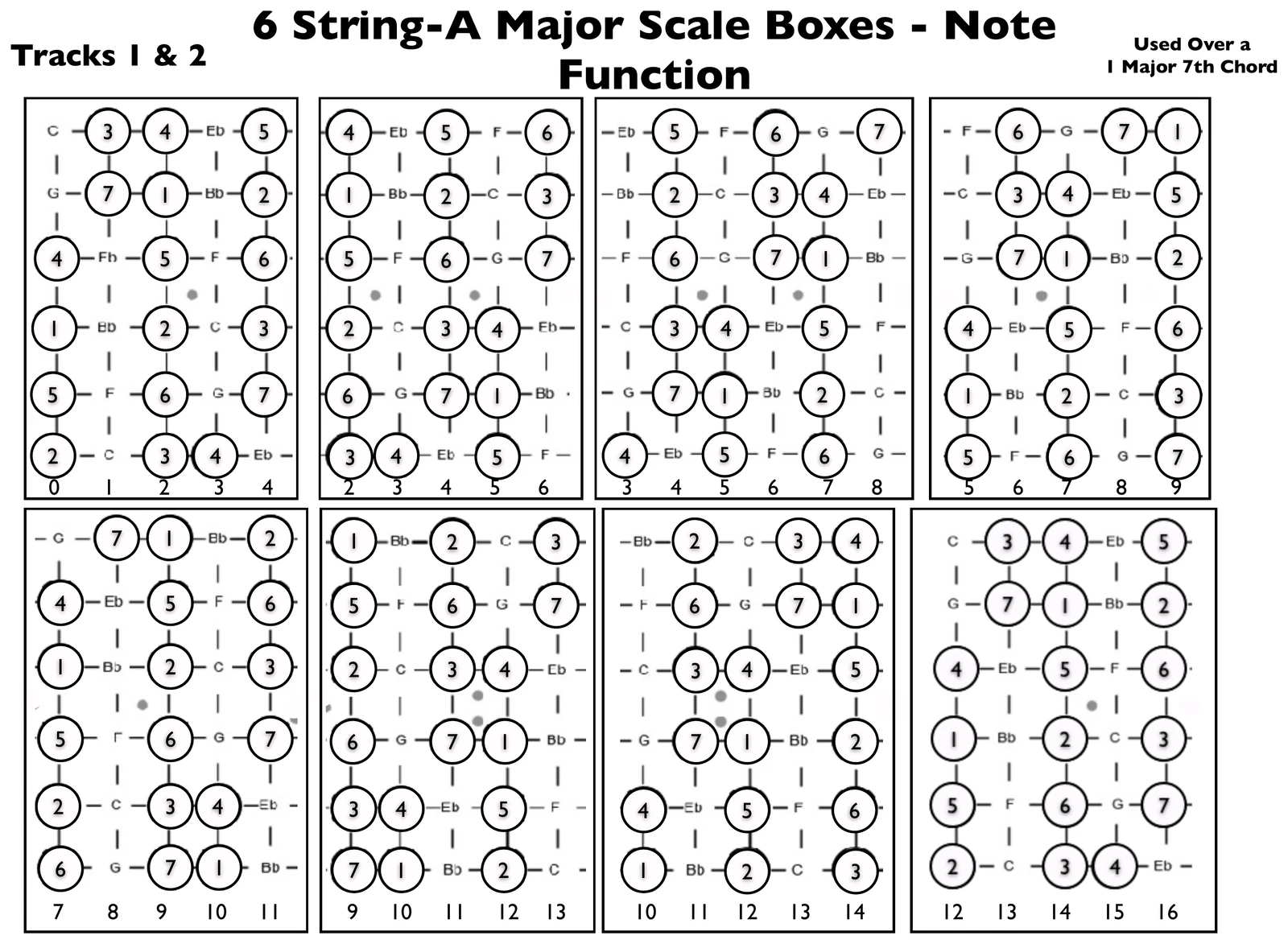
What the pages do not show is how to work them, which is the part that actually makes the difference. That is what we do together in a lesson.
Scale degrees work the same in every key
Chords have function numbers too. In the key of A major, the three minors you would play from the key are B minor (2 minor), C# minor (3 minor), and F# minor (6 minor). If you see that C# minor and you reach for the mode everybody is most comfortable with, the Dorian mode, over that 3 minor, it's not going to sound right. You have to be able to identify the chord by its function, and then know which scale goes with it. The number system is what lets you make that identification in any key without starting over, so you learn the shapes once, by function, and you have learned them in all 12 keys!
Putting the chord tones on the downbeats
Knowing where the notes are is one thing, and using them is the next thing. What makes a line work harmonically comes down to your ability to control which note function numbers go where in the rhythm, the same way your words have to fall in a certain order for the idea to get across when you are talking to somebody. A basic example of that would be chord tones on the downbeats.
Take a C7 chord, eighth notes, counted one-and-two-and-three-and-four-and. If I just run straight down the C dominant scale, the line sounds okay, but it doesn't really work. The chord tones are landing on the upbeats instead of the downbeats. The 1 is on the downbeat, the flat 7 is on the upbeat, the 6 is on the downbeat, 5 is on the upbeat, 4 is on the downbeat, and 3 is on the upbeat. All the notes I want on the strong beats are in the wrong place.
To solve that problem I put one chromatic passing tone in between the root and the flat 7, which forces every chord tone onto a downbeat, and the line sounds a whole lot better right away! That is what knowing the numbers buys you. You are deliberately placing 1, 3, 5, and flat 7 where they belong rhythmically and using the rest of the scale tones to connect them. Once you have internalized all of that, you are not thinking about the mathematics anymore, you are just hearing it and playing, but you got there by being educated in the grammar part of it first.
Key takeaways
- Rote one-octave scale practice is not the way you are going to use scales on stage. The goal is to know where every scale note lives so your hands go there without you thinking about it.
- Scale degrees 1 through 7 are defined by their distance relationship to 1 and not by pitch, and that is what makes the 12 keys learnable as one system.
- Three scale notes per string gives you seven box shapes named by the note function of their lowest note (five box, six box, seven box, and so on), and they are identical in every key.
- Application comes down to rhythmic placement. The numbers let you see and fix a bad placement instead of hoping a run sounds right.
Scale navigation is one of the fundamentals I teach. For the earlier, shorter take on the same idea, see a new way to look at scales. For the horizontal extension, connecting the boxes along the neck, see navigating scale notes on the neck. For a structured path through scales, triads, and the application work that turns them into real bass lines, online bass lessons via Zoom are available.
Read the transcript
Every time I talk about scales, my first question is: what is music? It's language, right? So again, you need to treat it like one. I look at the notes as the alphabet, or the vocabulary, for the language of music. Notes are organized into scales for a lot of the same reason that letters are organized into words, words into sentences, sentences into paragraphs. It's a way to organize the material to use it to communicate. So I look at scales as an organizational process.
Most people wouldn't say, okay, we're going to work on scales — first thing that comes to mind is something like this, right? Has anybody ever heard anybody get on stage and do that? I know I haven't. So spending a lot of time there probably isn't a good idea, because you're simply just not going to use the thing that way. I mean, for a hand exercise and listening to what the scale sounds like in this basic form, sure. But that's not the way you're going to actually use it.
So the idea, technically speaking, is matching the right scale to the right chord. Because when you're playing the song, you're going to have a chord that's being played, and the notes you're going to use to outline that chord sound — whether it be a bass line or a solo — are going to come from the notes of the scale that go with that chord. Those notes are going to sound good. This is a major chord sound. If I play the notes of the A major scale — the idea is I need to know where all those notes are, to the point where I'm not thinking about what I would play any more than I think about each chord. I would say right now I'm not thinking about any of it, I'm just hearing and playing. But I was able to control the notes enough that I was restricting my choices just to those notes. Maybe different versions of them, but just the notes of the scale. So that's the idea: you want to learn where all the notes of a scale are on the fingerboard, as opposed to just a couple of ways of going up and down, so that you learn them well enough that you just hear and your hands just simply know where to go. The same way your mouth knows how to move when you talk.
When you think about the two languages, the spoken language is much more complex than the language of music. That's why you can always tell if you're talking to a computer on the telephone — technology hasn't gotten to the point where they can reproduce all the inflections of human speech. It's getting close, but you can always kind of tell. There's a lot more going on. So there's a lot of information to learn, but if you look at it like learning a language, it really kind of simplifies things. It makes the understanding of why to work on a lot of the tedious stuff a little bit easier to take. Because some of us sitting down — it's not real exciting stuff to work on, but if you want to get good, you've got to do it.
Some musical terms to understand. Intervals — everybody know the definition of that word? Distance between two notes. It's just a distance in sound. The smallest interval in Western music is the half step. Next biggest distance, a whole step. Most scales are comprised of different combinations of whole step and half step intervals, and it always must stay the same for the scale to be what it is. So it's really about a distance relationship from 1 to all the other notes of the scale. That's what makes it what it is.
So these scale notes are the A major scale, because A we call 1, and then the second note, which happens to be B — B's really not important here, it just happened to be at the right place at the right time. What's important is that's 2, and 2 is always a whole step up from 1. You cannot call it 2 unless it has that relationship to 1. Then 3 is a whole step up from 2, 4 is a half step up from 3, 5 is a whole step up from 4, 6 is a whole step up from 5, 7 is a whole step up from 6, and 1 is again a half step up from 7. A major scale can only exist like that. That's what makes it the major scale, because we call A 1, and then the rest of the notes fall in that distance formula. And all scales are defined by this relationship: you establish 1, then you look at the relationship distances, and that's how you know what it is.
It's important to know what it is because when you're playing over chord progressions, chords have function numbers too that define what they are. In the major scale modes — and I know I'm probably jumping ahead, so if you don't get all of what I'm saying here, don't worry about it — but basically, we have three minors that we could play in the key of A. We have two minor, B minor. Three, C# minor. Six, F# minor. So if we're playing in the key of A and we see a C# minor, we can't just play the normal scale that everybody's probably comfortable with — the Dorian mode — over that three minor. It's not going to sound right. So you have to be able to identify the chord, then know which scale goes with it. By learning this number system, that's the way you make these identifications and pick the right choice.
So how do we learn where all the notes are? What we do is break them down into three scale notes per string, with each scale note on your lowest string starting its own scale pattern, or what I call a box of notes. If I take out everything but the first three scale notes per string — I would call that the E box, or the five box, because the note-function-formula number of that, if A is 1 and I go up five notes with that whole-step / half-step formula, I'm going to end up 1, 2, 3, 4, 5 — E is 5. Because of its note function number, I name it the five box. The cool thing about the numbers is that shape is always going to be the five box no matter what key it is. Identifying it with numbers turns the 12 keys into one thing. Simplifies it tremendously.
I'm skipping a lot of stuff here — it's a lot more detailed — so raise your hand if it gets to be where you're not getting what I'm talking about. If I go up to the next three scale notes per string, that box starting on F#, which is a 6, is always going to be next to that five box. The next three scale notes up are the seven box, and so on. If we know this shape is here, this shape's next to that one, this shape's next to that one — we have seven different shapes corresponding with the seven different notes of the scale. These shapes are the same in every key. They may be in a different place on the neck, but the shapes are the same, and the relationship of one shape to the others is the same.
For example, let's say I'm doing what I would call the seven box here: 7, 1, 2, 3, 4, 5, 6, 7, 1, 2, 3, 4. Well, I know that one's next to that one, that one's next to that one, that one's next to that one — all of a sudden my neck opens up. I know where everything is. Pick a key — C. Well, I know that box starts on 7, and 7 is always a half step below 1. Seven box: 1, 2, 3, 7, 1, 2, 3, 4, 5, 6, 7, 1, 2, 3, 4. I just did that same shape, but I started in relationship to C. Well, that seven box — I know one box is here, two box is here, three box is here.
The fingering answer: when you actually work on them, I break up the boxes individually. You have your fret numbers down the bottom to orient yourself on your fingerboard. I have the note name version so you can correlate that with what you're looking at on the fingerboard, and I have the fingering inside the circles — the left-hand finger numbers. So for the open two four, open two four, open two four, one two four. For the six box: one three four, one three four, one two four stretch, one two four stretch. You also have an option of using one two three here, because if you're moving quickly, if you watch what the hand has to do to go from a one three four fingering to a one two four stretch fingering — that movement — if I do a one two three, I take that movement out. You can bust through quick. I couldn't move from one three four to one two four stretch like that, just too much left-hand moving. So you have some options depending on how fast you're playing.
Once you get the fingering down, you go to the next slide and it has the note function numbers, and this is where the clock really starts ticking, because this is how you identify everything. You call out these numbers: 5, 6, 7, 1, 2, 3, 4, 5, 6, 7, 2, 1, 7, 6, 5, 4, 3, 2, 1, 7, 6, 5. It's like knowing how a word is spelled — you're not thinking about it, but I bet if I stopped you mid-sentence you'd be able to tell me. When I'm playing, I'm not thinking of that stuff. I'm just hearing something and playing. But if you stop me on a note — okay, well, that's 6. I can tell you what it is. Not that it really matters, but it's kind of like jumping in the middle of the ABCs and saying them all the way around back to that.
So that's what my scale system is based on. It's basically geography — you learn where things are, and then you get into application. Application's interesting in the sense that if you were to ask me, okay, what defines a good line musically, harmonically speaking — a bass line or solo — what makes it work? Technically speaking, it comes down to your ability to control what note function numbers go where in the rhythm. Just like your words fall in a certain way to make sense when you talk to somebody. If you just spit out random words, you wouldn't hold somebody's attention very long. They have to fall in a certain order for the idea to get across. The way it works musically is what goes where rhythmically. A basic example would be chord tones on downbeats.
This is where the numbers come in — really knowing the note function numbers. If I have a C7 chord going, and the scale that goes with this is something called the C dominant seventh scale — or C Mixolydian, fifth major scale, don't worry about it — if I go down that scale it sounds okay, but it doesn't really work. Why doesn't it work? Because I'm putting the chord tones on the upbeats instead of the downbeats. If I'm doing eighth notes, they're going one-and-two-and-three-and-four-and. The 1 is on the downbeat, the flat-7 chord tone is on the upbeat, the 6th scale tone is on the downbeat, 5 is on the upbeat, major chord tone 4 is on the downbeat — probably the one that sounds the least good — 3 is on the upbeat. All the notes I want on the downbeats aren't there. So to solve that problem, I put a note in between the root and the flat 7 to force the chord tones on the downbeats. Now listen to the difference — the line sounds a lot better.
That's why you learn the numbers. When you get into the application part of it, you start working in mathematics, and then you internalize that information where you just learn to hear these sounds and play by ear. You end up getting there, but you're coming from a point of being educated in the grammar part of it, so it gives you more control over the manipulation. I could say, okay, I'm going to go down one chromatic passing tone, flat 7, 6, 5. I'm going to go up an arpeggio on the flat 7 — flat 7, 9, 11, 13, resolving to 5, 4, 3, 2, 1. Chromatic passing tone, flat 7, 6, 5, 4, up on the 3 — 3, 5, flat 7, 9, resolving to 1. I'm able to actually think through something to work on developing my ear to get these sounds together. Once you get the geography of this stuff down, then you get into this type of work where you actually start working stuff out and creating lines that you deliberately plug in.
When people improvise, you're not really creating stuff that nobody's ever done before. That's not the way it works. It's like a language. How many times during the course of a day do you actually invent a new word that nobody's ever used before and start using it? Languages don't work that way. What you do is use the same words that everybody's used forever, but you say them always in a way that's uniquely you. When you start playing this stuff — that was just me talking, but I was using stuff that wasn't anything nobody's never played before. I put it together in a way that was just Russ talking. That's all. So it gets back to the language thing. Conceptually it's so simple, it's hard.
That's why people who actually learn by ear are coming from the right place. How do you learn language? When you're a kid, you listen, imitate, and talk. You don't start with sentence structure. That's why music's hard for a lot of people, I think — because it's taught backwards. It's taught from the technical end first. It's like explaining sentence structure to somebody who can't talk yet. It's not going to make sense, because you have nothing to relate it to. So you learn how to play, then you study. But because of the educational system, we're almost kind of stuck with that technical thing first. So what I try to do in my stuff is blend these two areas together — get you playing, but at the same time, yeah, well, this is called that — and kind of get these balanced and grow together.