Triads are the key. I used to think it was scales. It's not. A triad is the basis of everything, the basis of the chord structure, the basis of the harmony, and the basis of the note choices you make in any bass line or any solo, and the notes of the scale are simply ways to connect those triad notes. I taught scales as the foundation for years, and these days I teach the scale and then get right into the importance of triads, because that is where everything else comes from.
What a triad actually is
A triad is the 1-3-5 of a scale, three notes stacked out of that parent scale that give you the core sound of a chord. There are four flavors you need to know, and those are major, minor, diminished, and augmented. Once you understand that the triad is the 1-3-5, you know what it is technically, you are oriented to that set of notes, and you can start applying them.
The backwards part about it is that you cannot really teach triads first, at least I have tried that and it does not make sense to people. Students ask where the triad comes from, and the honest answer is that it comes from the scale, which kind of means you need to understand the scale first. That is why I teach the scale and then get right into the importance of triads.
Triads are the foundation and scale notes connect them
This is the part I want you to sit with. A triad is musical, it is the basis of the chord structure and it is the basis of the harmony. Everything in a bass line comes from it and is centered around it, both in how you navigate them rhythmically and of course in the notes you choose. The notes of the scale are simply ways to connect those triad notes together.
That flip changes how you practice. Rather than spending all of your time running scales, you are building lines out of the 1-3-5 and using the other scale tones to move between them. The triad is the core of the line, and those triad notes really are the life's blood of all your bass lines, past, present, and future!
7ths, 9ths, 11ths, 13ths are upper-structure chord tones
Once you've got the triad as your core, you can look at 7th chords and extensions (the 9, the 11, and the 13) as upper-structure chord tones. From that angle you can actually look at every note of a scale as being a chord tone in one way or another, and it is just how you use them. That is a much more useful way to think about note choice than "scale notes versus non-scale notes", because every note inside the scale can function harmonically and what you are really doing is controlling what goes where.
The practice prescription
Get out your shovel and dig on this exercise with major, minor, diminished, and augmented triads. Feel free to find new and inventive and creative ways of mixing up string combinations, note combinations, and inversions, because there is never any traffic on the extra mile. Spend most of your time on major and minor, and that is ninety-five percent of it right there. The diminished is pretty much going to fall into the minor category, so if you really know your minors you are not learning a completely different thing, and the augmented rounds it out. Beat the crap out of these triads every way you can!!
This is one page out of the triad material I hand my students, so you can see what the map looks like.
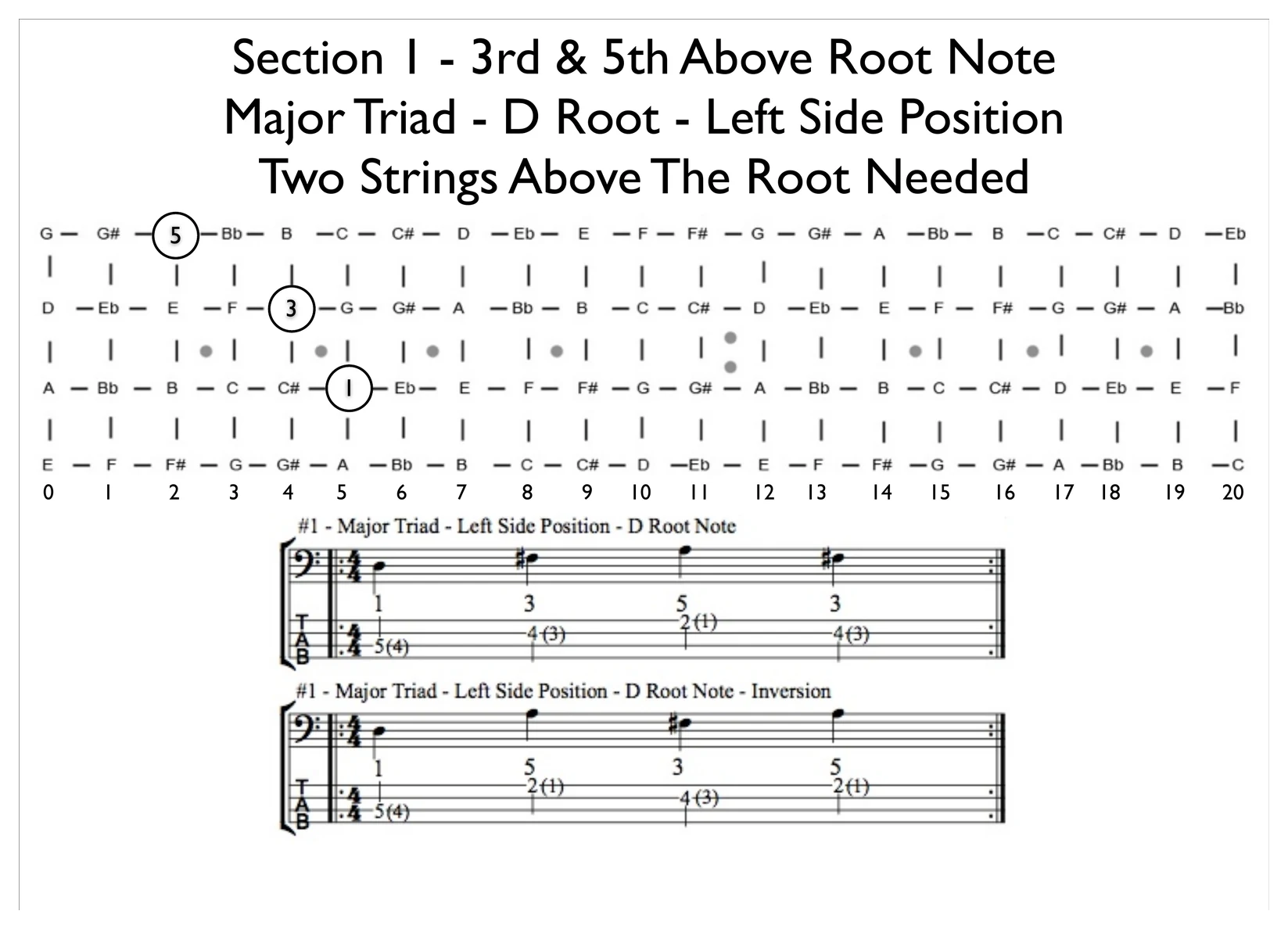
The whole neck is written out, and the root, the third above it, and the fifth are circled where they sit under your hand, with the same thing in notation and tab underneath. This is one position for one triad. The full set maps every triad flavor in every position, and that is the material we work through together.
Dig in this order:
- Work major and minor triads first, because they carry the bulk of the harmonic work you will ever do.
- Add the diminished triad by flatting the 5 of the minor triad, and do not treat it as a new shape, treat it as a minor variant.
- Add the augmented triad to round out the four flavors.
- Play all four triads and their inversions up and down the neck, in every key.
- Start on any note, any position, any string combination, and rhythmically group them however you want.
- The goal is to bust up and down effortlessly, without any hesitation, starting on any note-function number in any key. The better you know those guys, the more free you are going to be to create any which way you want on the bass!
Key takeaways
- Triads, the 1-3-5 of a scale, are the basis of chord structure and harmony, and they drive the note choices in every bass line you play.
- The notes of the scale are simply ways to connect the triad notes. The triad is the core of the line, and the scale notes connect the triad notes together.
- 7ths, 9ths, 11ths, and 13ths are upper-structure chord tones, which means every note in a scale can function as a chord tone depending on how you use it.
- Work major and minor first (that is ninety-five percent of the work), then add diminished (minor with a flat 5) and augmented, in every key, every position, up and down the neck.
Harmony is one of the fundamentals I teach, and triads are where the real harmonic work starts. Once you're sold on why triads matter, the next step is getting them physically under your fingers, so see fingering positions for triads on your bass neck for the "how." If you want a structured path through all of this, online bass lessons via Zoom are available.