Originally published June 7, 2013, lightly edited for clarity.
I believe the quality of your playing will come down to the choices you make for your right and left hand technique. With right hand form choices, I think that the floating thumb, used with the 2, 3, or 4 finger picking technique, works the best because of its simplicity and effectiveness. With one basic position, the hand works in its most relaxed position on all strings and keeps the lower strings quiet while playing on the higher ones. I recommend always trying to work from the most relaxed hand position as you can come up with. Right-hand technique is one of the fundamentals I teach. If you want personalized feedback on your right-hand form, online bass lessons via Zoom are available.
Read the transcript
The thing about the floating thumb is it does two things very well. First, it keeps your hand always in its most relaxed position, you know. If you just relax your hand, it's always in that very relaxed place. Also, it keeps the lower strings quiet while you're playing on the higher ones, because the thumb is lying flat on the strings as you go up.
Now, on a four-string bass you haven't got as much to keep up with, but basically, when I'm playing on my E string, now this is going to sound different because I'm going to do it on the bottom four of my bass, because my right hand will do the same thing as yours would on a four-string. Okay, so when I'm playing on what would be your E string, my thumb sits on the pickup, just kind of laying light, you know, flat there. Also, I keep my arm off the bass, you know, because this is important for two reasons. Because you don't want pressure pushing on the inside of the arm here, because it's going to restrict blood flow out of the hand. All right, so keeping the arm off the bass is a good idea.
All right, so when I'm picking on what would be your E string, my thumb's just sitting on the pickup, very close to the E string. Then when I go to what would be your A, my thumb slides up on top of the E string, actually sits, just lies on top of it, not up against it like yours is, like sitting up against it. It actually sits on top of it. Ah, okay. Yeah, all right. And so the way the hand is when playing on the E string is exactly the way the hand is when playing on the A. Now when I go to what would be your D, now my thumb sits lightly on the E and A string, it's actually just sitting on both of them, and then I'm playing what would be your D. And then when I go to the G string, now my thumb is sitting on the E, A, and D, and I'm playing on the G. Right? So no matter where I'm playing, my hand is always in that same exact place.
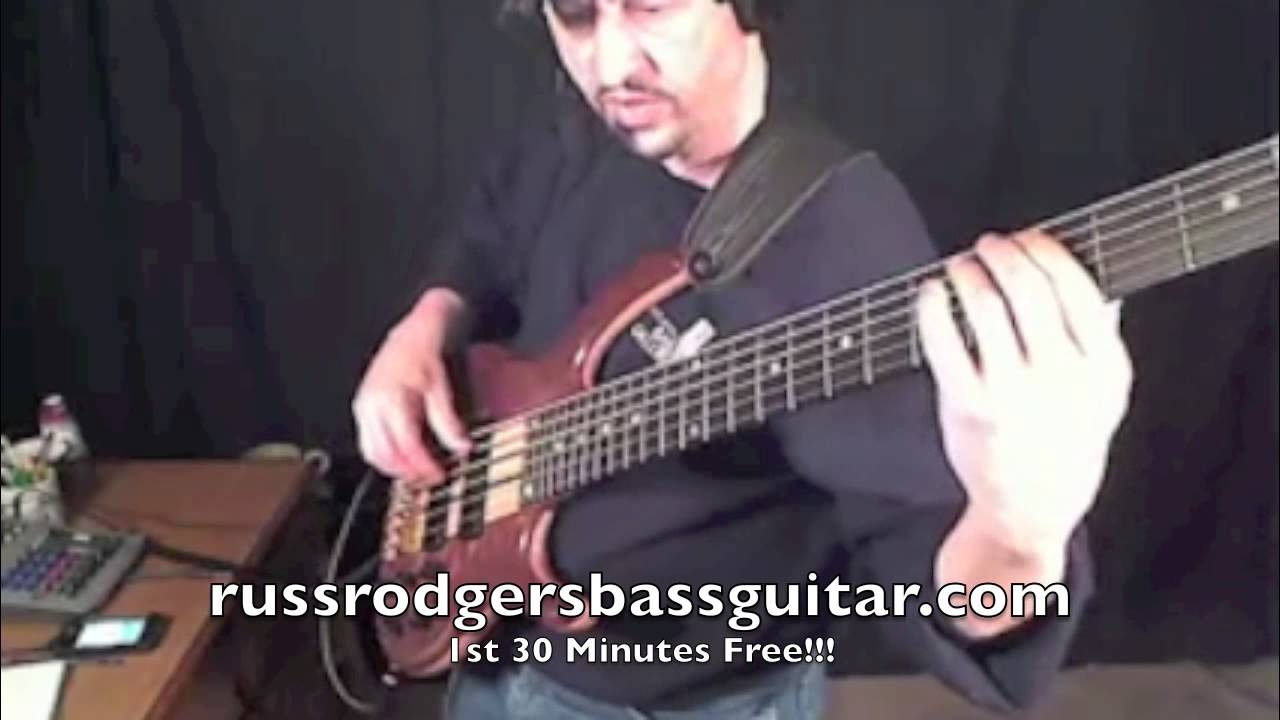
And another good thing about this is if you ever choose to go to a five or six string bass later, you don't have to change your right-hand technique. It just keeps going. Nothing really changes there. So it's very efficient, user-friendly for, you know, four, five, and six string bass right-hand technique. And I like it because mainly it keeps my hand in a very relaxed place, because on this bass, you see, I have a long way to go from here to here. So if I kept my thumb here, I would have to reach the hand like that to get to the E string. So anytime you start opening up the hand, you're starting to engage other muscles, right? So it's just like trying to work in the most relaxed place, to where the only thing that's really moving here is these fingers. There's nothing else really working in the hand, right? Right. So this is just a very efficient, relaxed way to do it. And that's it, it's called the floating thumb, because the thumb floats on top of the strings as you go up.
The other technique that's popular is something called the movable anchor, to where basically you do what you were doing like on the E string, you sit on the edge of the pickup, then when you go to the E string, you sit against the E string, and then the thumb just follows, you know, sits on each string as it goes up. Now the problem is, like, when you're playing on your G string, your thumb would be sitting on your D and probably touching the D and the A, but nothing's keeping the E string quiet. That's a disadvantage of this technique. Ah, gotcha. Right. And then there's something called the fixed anchor, to where you can just plant your thumb somewhere and then the hand just moves this way to get. That's a lot more work, I feel it. Yeah, and plus you have no muting techniques. You have no muting, you know, availability to you. Gotcha.
All right, so anyway, you know, it's basically, you know, you think about what you want to do and which one of these you want to use, and just start working on it, and then you'll have to deal with the muting issues as they come up. But with the floating, I think I'm gonna go with the floating. It's like the best, I think it is. I think it is.
You know, I actually played with kind of a movable anchor to a degree, and I used my second and third fingers to touch other strings, and I was working real hard. I mean, it worked, but you know, I was working five times as hard as I needed to. And so I actually, it almost took me two years to reorganize my right hand, because I'd been playing thirty years the other way. Right. So I mean, it was like, you know, it was a long, tedious process to change that, but I knew I needed to do it, and there would never be a good time, you know, at this point. So I either decided to do it, or, you know, let it go. So I went, said, okay, you know, I went to the guys in the band, said, okay, it's going to be a little rough here for a minute, but I'm changing some stuff around. But now, so I'm really glad I did it. It wasn't an easy process, but you know, you have a lot less muscle memory to turn around, so this would be a good time for you to do it, or whatever you decide to do, it'd be a good time to really do that, and find a thing that's really going to work for you, and, you know, play as much that way as you can.
There's always going to be things that you'll change about a technique to achieve a musical result, you know. But I call my floating thumb my default position. In other words, when my hand goes back to its most relaxed place, to where it likes to be, that's what it is. But I might change it to, you know, achieve something, but as soon as I'm done with it, I go back to the default position. So it's okay to kind of vary from that as needed, you know, because there's always going to be musical situations that are going to require your hand to potentially do something that, you know, normally would be considered, well, that's probably not a good idea, but for this particular situation, it's the right choice.
Right. Do you ever do slap style? Yeah, you do. Yeah. And then you have to rethink your whole muting thing, because then it becomes more of the left hand's job, because the right hand's no longer able to do it. Plus, I use this little hair scrunchy thing and keep it right there, it helps keep some of the strings quiet, but I have to use a left hand thing to keep most of this quiet now. So I'll do a lot of this kind of stuff, which is really contrary to my normal left-hand way of playing, but it's necessary for this particular style. So I'm doing a lot of for.