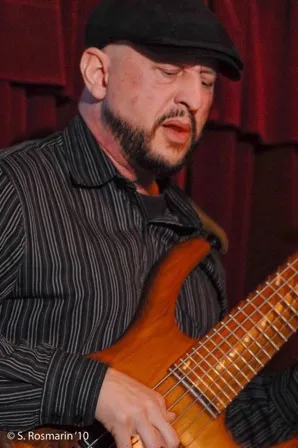
Originally published July 21, 2014, lightly edited for clarity.
I have had a lot of students over the years say that they had heard you should avoid open strings when playing your lines on bass guitar. The only thing I have found to watch out for with open strings is to make sure they do not sonically disrupt the flow of the line because the sound of an open string note is different from that of a fretted note. If the notes are moving fast enough, this is usually not a problem. The longer I play and teach bass guitar, the more I believe the choices you make with your hand positions and fingering should be what ever makes the most sense to do at that moment balanced with whatever is the most relaxed way to use the hands. The following video walks through these points. Fingering technique is one of the fundamentals I teach. For personalized coaching on fingering and open-string choices, online bass lessons via Zoom are available.
Read the transcript
Kind of dictate kind of what position it's in. Do you use open strings very often, or do you try to keep... Yeah, every day. Okay. I know a lot of people say avoid open strings at all cost. No, no, man, they're my best friend. They're great for shift points, that's their biggest asset, you know what I mean? But if it makes something easier to play, and it doesn't sonically disrupt the flow of the line. Because the thing about open strings that bugs people is that they sound different, right? And depending on how you have your bass EQ, what kind of strings you're using, how new those strings are, a lot of different factors will go into how different it will sound. Okay, yeah.
But you know, if I'm like walking Giant Steps or something, nobody's gonna know. There's no way, right? It's moving too fast, you know? Yeah. And I'm using those open strings to make things easier, rather than trying to grab close notes just because somebody said don't play open strings. Right. So I think the judgment call should actually come from your own ear. Or, so, you're working for somebody and they say, no, don't use that note, I don't like the way it sounds, you know what I mean? Because as you know, whoever's writing the check, that's how the song goes. But of course. But you know, as far as you know, you've got to use your own musical judgment. If it sounds fine, then use it. If it makes it easier for your hands, why not?
It's the same argument as, like, you should alternate on everything you play with the right hand fingers, right? You know what I mean? That's ridiculous. There's no reason to alternate on certain things, because you're working three times as harder than you have to. But there are certain situations where you do have to alternate, which is why you should practice alternations, right? But it doesn't mean, like, if I were doing something, why would I want to go one two, one two, one two, one two, one two, one two, when I could go one one one, two two two, one one, two two, and make it much easier to play? Okay, yeah.
So I mean, it really comes down to a musical judgment call on what makes sense, what's practical. You have to balance these things. And if it doesn't sound any different, nobody's going to know, then why not? Sure, sure. Okay, but anyway.