Read the transcript
Okay, now a good way to work on memorizing this chord progression, plus build chordal ear training, is to play the track and call out chords as you're listening to it, okay? A minor seven, D seven, G major seven, C major seven, F sharp minor seven flat five, B seven, E minor seven, A minor seven, D seven. Right, okay, that's a good way to do it.
One of the big reasons for memorizing this chord progression is that it's going to enable you to work, or allow you to work, in constructing, composing these bass lines while looking at your fingerboard and staying really visually focused there, right, rather than being distracted by the chart. Okay, plus it's also good, it's important, as I'm sure you know from your playing experience, to learn chord progressions quickly, right? Right. So I mean, practicing doing that is going to be a good thing for a lot of different reasons, but for our immediate purposes, it's to enable you to just stay focused on your neck as you do these triads and compose them, and also compose them on the spot, you know, actually improvising, because all improvising is is composing fast, right?
So in any case, getting the chord progression memorized, number one. Secondly, we want to work in finding the possibilities, because we want to limit our choices to the first five frets, open string through the first five frets, so, you know, six frets out of bounds, okay? And the reason we're doing this is it's going to force you to use all the permutations in order to come up with variety in your lines. Now, we're going to open up the neck shortly, but for right now I want you to stay in the first five frets, okay? But you can use open strings too, okay?
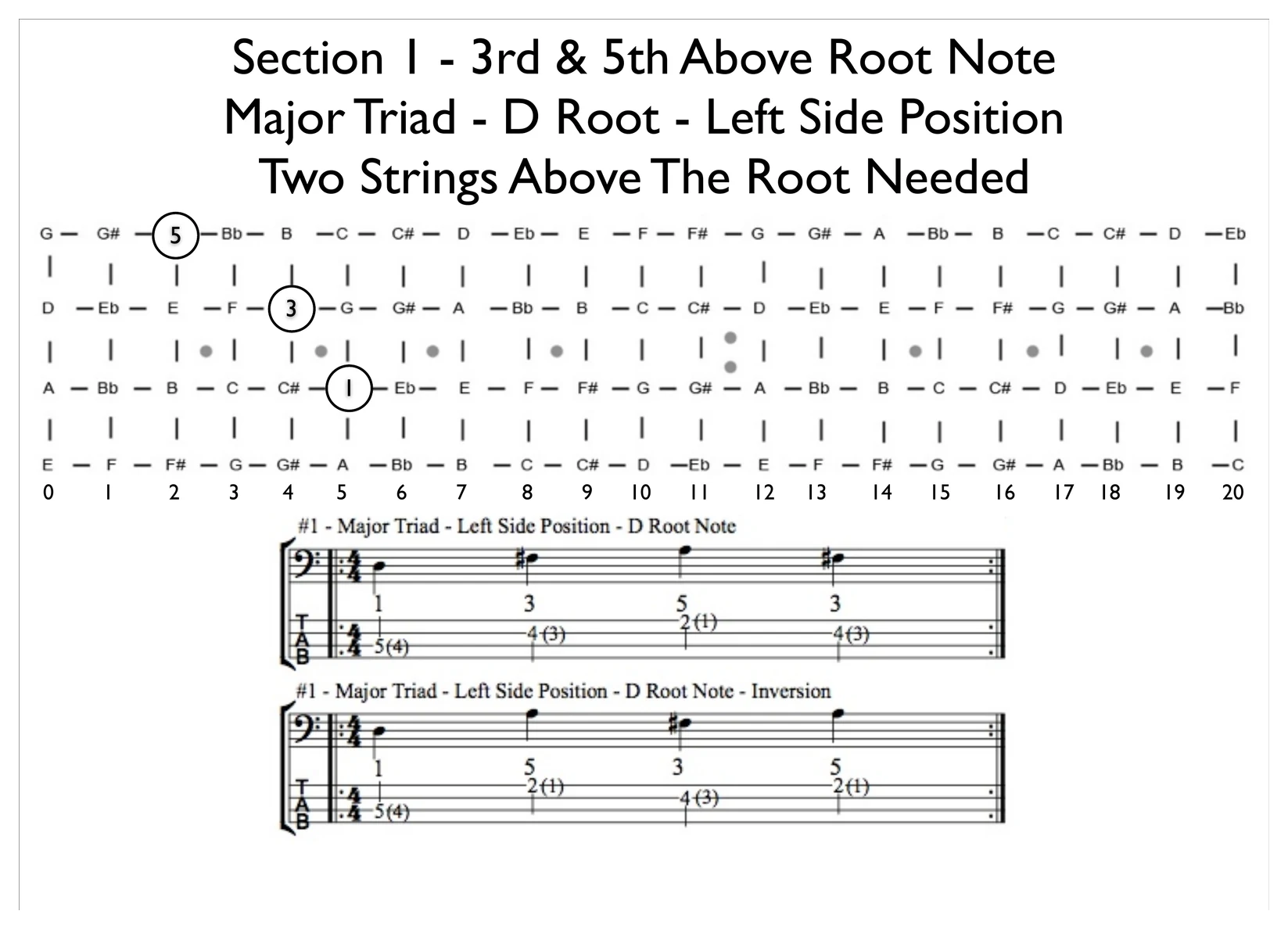
All right, so the next thing to do is to go through and kind of do a recon on it, and, you know, see what possibilities of sections and positions you have for each chord, okay, and be able to identify them. For example, on the A minor, I can say, okay, well, I've got a left side position minor triad, one, flat three, five, flat three, one, five, flat three, five, and that includes this inversion, right?
I've got a section two, left side position, one, flat three, five, flat three, one, five, flat three, five. I've got a section one, right side position, and this would be starting on the open string, one, flat three, five, flat three, one, five, flat three, five. Now, that sounds exactly like the first one I did, because of the exact same pitches, however, they do involve two different positions, right?
Now I also have a section three, one, flat three, five, flat three, one, five, flat three, five, that's a right side position, section three. Okay, I have a left side position, I'm sorry, a center position, section three, one, flat three, five, flat three, one, five, flat three, five. I have a right side position, section one, starting on the second fret of the G string, one, flat three, five, flat three, one, five, flat three, five. I have a section three, starting on the second fret of the G string, one, flat three, five, flat three, one, five, flat three, five.
So I've got all these different ways to configure this triad in the format that we've laid out, using the one, three, five, three, and one, five, three, five combination. And you want me only to do this in triads.
All right, so I'm going to start with A minor, and what I do is I say, okay, you don't have to actually, well, you should be able to, you should know what position and section you're in, so I'm going to do a left side position, section one, start off there: one, flat three, five, flat three. Now I've used up the first measure of A minor with four notes, right? So now I've got to pick the root note of the next chord.
Now, some rules about what are our choices here. The first beat is going to be the root note. For now we're going to have a temporary rule in place that the first beat of each new chord has to be a one, okay? All right, now that rule will change later, but for right now it's in place, right? Right. So that means that I've got to pick a D. Now, the next rule is going to be that we have to pick the root note as close to the fourth beat note of the preceding chord as possible, okay?
All right, so if I go one, flat three, five, flat three, my closest D root note is going to be a whole step up on the A string, right? What would be incorrect and breaking the rules at this point would be this: one, flat three, five, flat three, one, three, five. You know, that's too far away. Now, there are ways to connect like that, but we're not there yet, right?
Right, so one, flat three, five, flat three, so I have to go either to this note on the fifth fret of the A string, or open D, either one or five, because of the same pitch, but I'm going to pick, I'm going to pick the fifth fret on the A string, right? So now I do a triad on the D. So let me think, well, okay, I'll do a section two, left side position, but I'll do the inversion, one, five, three, five. So now I've got the two chords, and I, you know, I piece it together like a puzzle: one, flat three, five, flat three, one, five, three, five.
Right, so now I want to go to the closest G, which is going to be the third fret on the E string, right? So I'm now going to do a center position, section one, one, three, five, three, major. Now I'm going to do a section three inversion on the C major, one, five, three, five. Now I'm going to do a right side position, section one, diminished, for the F sharp minor seven flat five, one, flat three, five, flat three. And now I'm going to do a section three, right side position, for the B, one, three, five, three, right side position, E minor, one, flat three, five, flat three. And because I have two bars of E minor, I want the second E minor triad, I do, I want to do it differently. So in this case I'll simply, and now I could pick a different, you know, section or position, but I'm just going to do the same one, but I'm going to do this inversion: step one, one, flat three, five, flat three, second I'm going to go one, five, flat three, five, to give it some variety.
So now I've got a line: one, flat three, five, flat three, one, three, five, three, one, five, three, five, one, three, I'm sorry, one, five, three, five, one, flat three, flat five, flat three, one, three, five, three, one, flat three, five, flat three, one, five, flat three, five, okay.
Okay, let's see how it works with the track. One.
So I have a perfectly functional walking bass line, clearly outlining these chord changes, that if I played this just by myself, it would be very obvious to somebody who knows a song. Oh, he's playing "Autumn Leaves," right? Okay.
Right, so if you come from this position of authority with your harmony, then when you start taking it out and applying stuff, and doing the more vague or abstract ways of doing walking bass lines, or adding different stuff to it, you're going to be coming from a very strong harmonic perspective. The mistake a lot of people make with their walking bass lines is they start trying to be too slick harmonically too soon, and they end up not really outlining the chord sound very well. They're not fulfilling their job, you know, they're not doing their bass line job.